Spanish miners were digging for gold in Oklahoma’s Wichita Mountains as far back as 1765, more than a century before Oklahoma was even a state. The gold never ran out. People just stopped looking for it.
With gold trading above $4,000 an ounce, you do not need to find much for a weekend of panning to pay for itself.
Here is the secret most people miss about gold prospecting in Oklahoma. The famous Wichita Mountains sit inside a wildlife refuge where prospecting is banned, but the waters that drain all that gold country are open to anyone who knows where to look.
The real gold is in the quiet rivers of the southeast. Yes, you can still find gold in Oklahoma today, especially along the Kiamichi River and East Cache Creek, where fine placer gold has been showing up in pans for more than a century. This guide covers every proven spot, the technique that works at each one, and the rules that keep your trip legal.
Our team of geologists and experienced rockhounds put this guide together the same way we approach every gold state. We looked at where the geology says gold should collect, then matched it against a century of documented finds. Here is everything you need to plan your first Oklahoma gold trip.
Table of Contents
- Biggest Discovery
- Types of Gold
- Where Gold Hides
- Best Places
- Techniques
- Real vs Fool’s Gold
- How Gold Got Here
- What To Bring
- Best Seasons
- Other Minerals
- Legal Rules
- FAQ
The Biggest Gold Discovery in Oklahoma History
Oklahoma’s biggest gold story starts with a mystery. Around 1890, prospectors poking through the Wichita Mountains stumbled onto abandoned mine workings that nobody could explain. The answer went back to 1765, when Spanish miners were already pulling gold from these hills.
Word spread fast. By 1901 a full gold rush was roaring across southwestern Oklahoma, and more than 2,000 mining claims were filed in the Wichita Mountains. Prospectors sank over 2,500 shafts, some reaching depths of more than 200 feet. Boom towns like Wildman, Golden Pass, and Oreana sprang up almost overnight, and more than a dozen smelters were built to process the ore.
The most exciting samples assayed at over $600 per ton back when gold sold for about $20 an ounce. At today’s prices, a single ton of ore that rich would be worth well over $100,000.
The big mining companies eventually moved on after a 1916 state geology report. But the fine gold that washed out of those mountains, and out of the Ouachitas in the southeast, is still sitting in Oklahoma’s creeks and rivers waiting for you.
The Kinds of Gold You Can Find in Oklahoma
Oklahoma gold is almost always fine textured placer gold, and knowing what it actually looks like is the difference between a great day and an empty vial. This is gold that hides in plain sight, which is exactly why so many people walk right past it.
Flour Gold
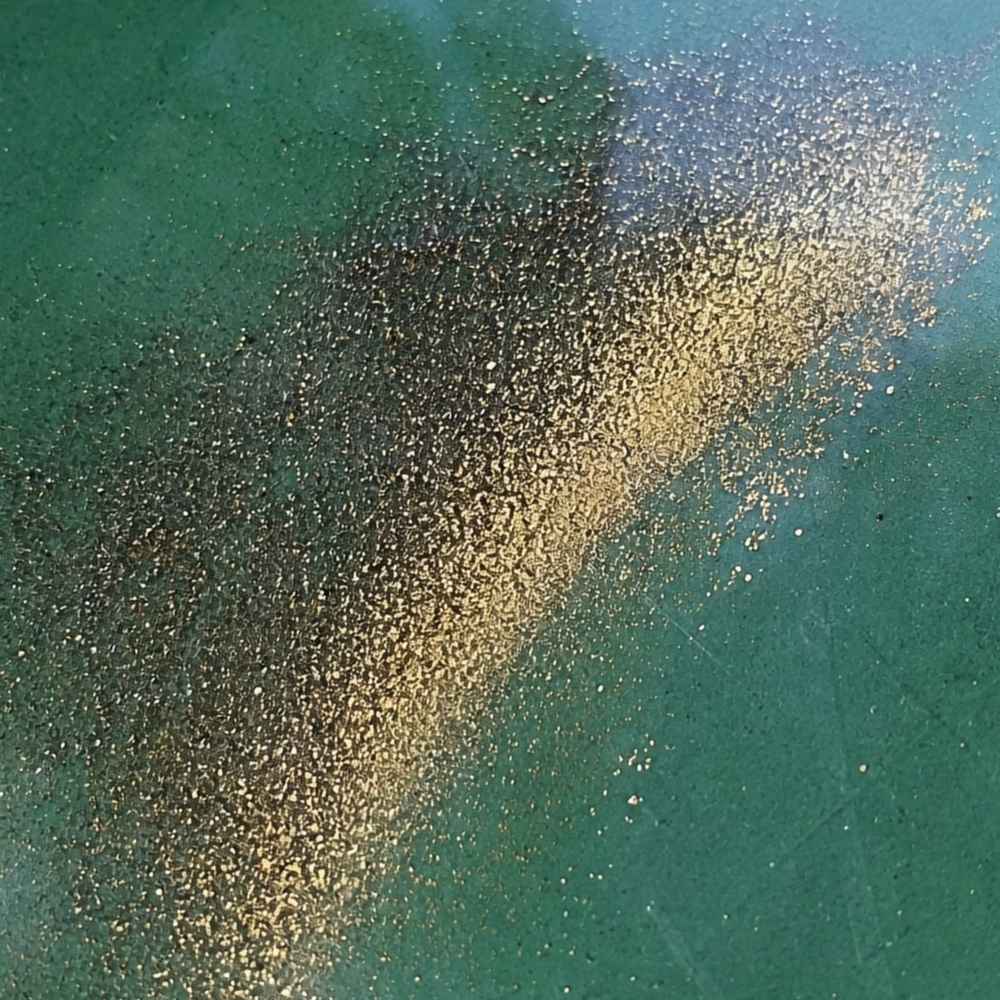
Flour gold is gold ground down to particles smaller than grains of sugar. It collects as a bright golden dust in the crease of your pan after everything lighter washes away. This is the most common form of gold in Oklahoma by far.
The mineral that fools people here is mica. Mica flashes silver or gold when it catches the sun, but it is nearly weightless. Real flour gold sinks straight to the bottom of your pan and stays golden in the shade, while mica floats, flutters, and goes dull the moment the light changes.
Because flour gold is so easy to wash out of a normal pan, you want a dedicated finish pan for your final concentrates. The Garrett Prospecting 10 Inch Backpacker Gold Pan is the one our team uses for exactly this job.
This is also the stage where a good identification reference saves your whole trip. The Rocks and Minerals of the United States Field Guide shows you exactly what real gold looks like next to every mineral that imitates it, so you know what you are looking at while your pan is still wet.
Gold Flakes
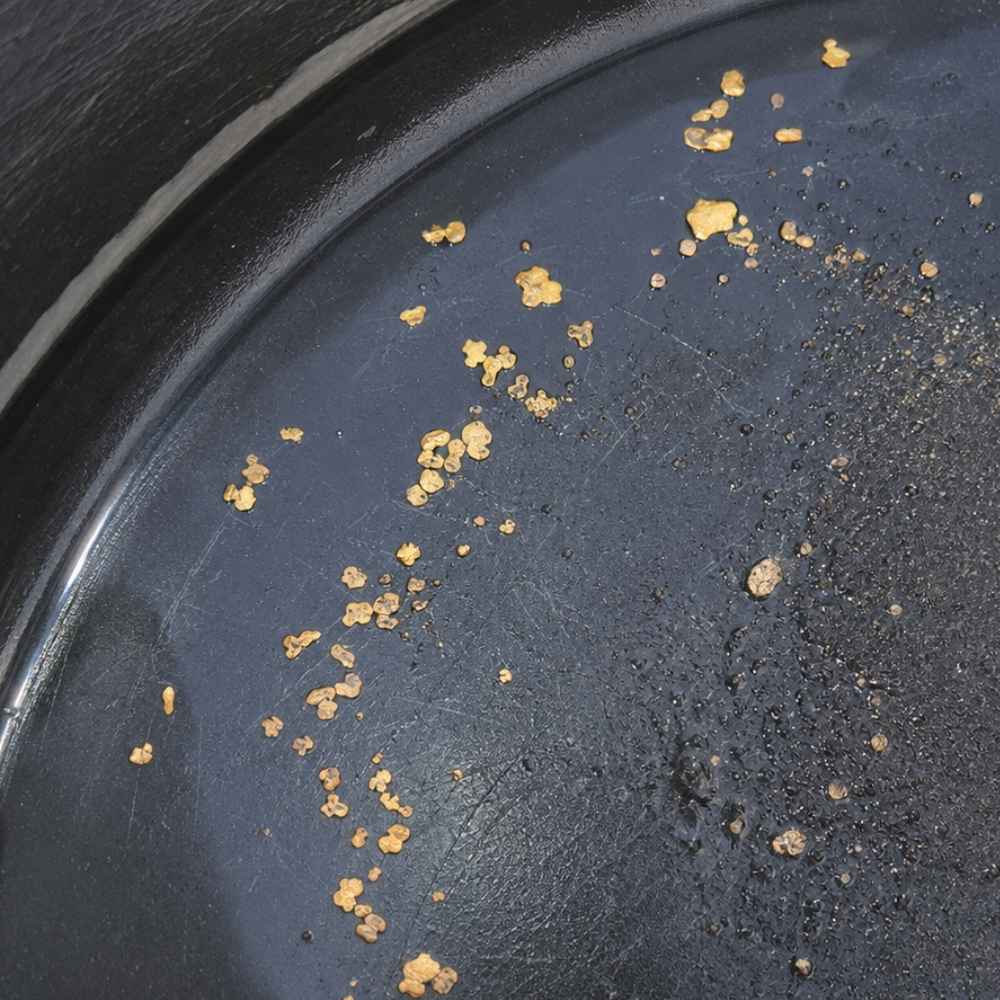
Flakes are the next size up, thin pieces about the size of a grass seed that you can actually pick out and admire. In Oklahoma these turn up most often in the southeastern rivers after spring floods move fresh gravel. A single good flake is a real trophy in Oklahoma.
The lookalike here is chalcopyrite, a brassy copper mineral that breaks into small glittery pieces. The test takes one second. Poke it with a pin, because gold dents like soft metal while chalcopyrite shatters or flakes apart.
Flakes are nearly impossible to pick up with wet fingers. A snuffer bottle like the Garrett Gold Guzzler Bottle sucks them straight out of your pan without losing a single one.
Gold in Quartz
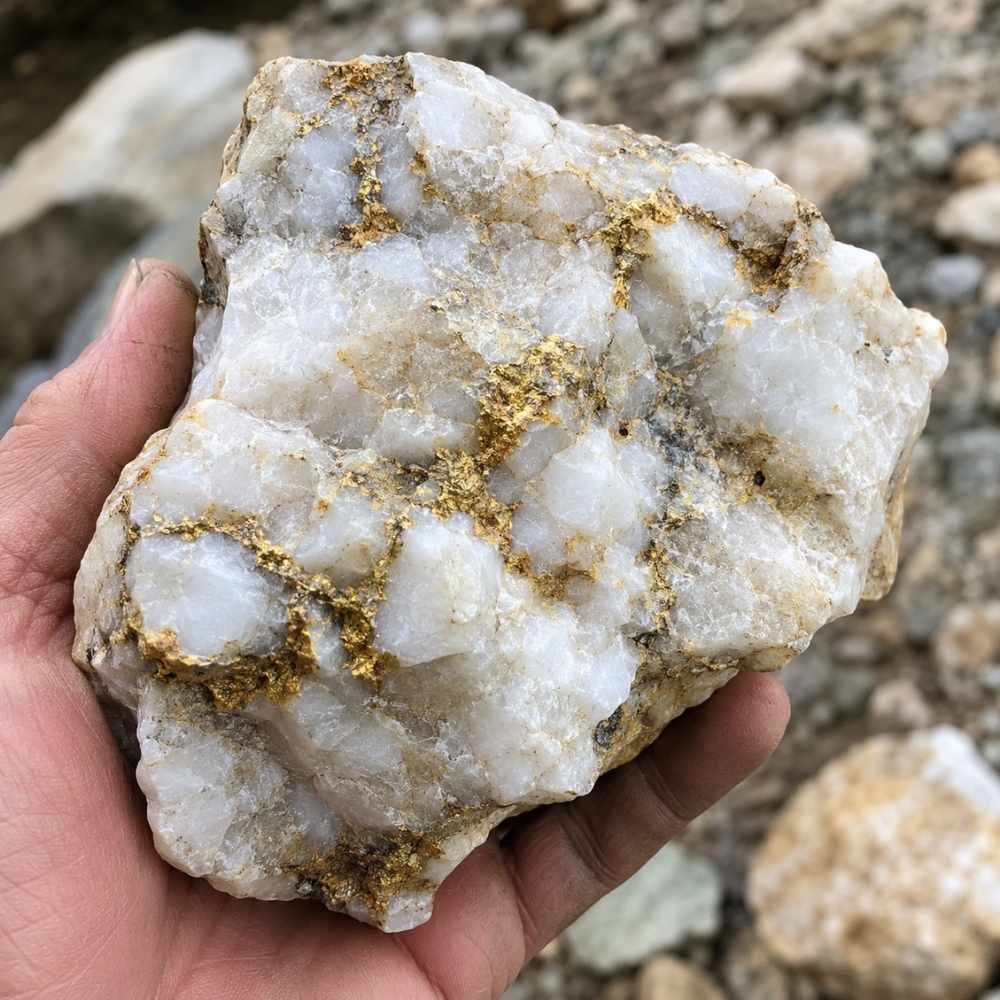
The mountains that shed all this placer gold still hold thin quartz veins carrying visible gold. In the Ouachitas and around the old Wichita Mountains diggings, sharp eyes sometimes spot rusty quartz with tiny golden specks locked inside. This is the rarest find in the state and the most exciting.
Pyrite embedded in quartz is the classic false alarm. Pyrite forms sharp little cubes with flat faces, while real gold in quartz looks like soft rounded blobs and threads with no crystal shape at all.
Cracking suspect quartz cleanly takes a real rock pick, not a hardware store hammer. The Estwing Geo Paleo Rock Pick is the standard tool for the job.
Knowing what the gold looks like is half the game. The other half is knowing where the river hides it and how to get it out, and that is exactly where this guide goes next.
Where Gold Hides in Oklahoma Streams
Gold is about 19 times heavier than water, so it always sinks to the lowest, slowest spot the current allows. Learn to read these five features and you can walk up to any river in this guide and know where to dig first.
Inside Bends
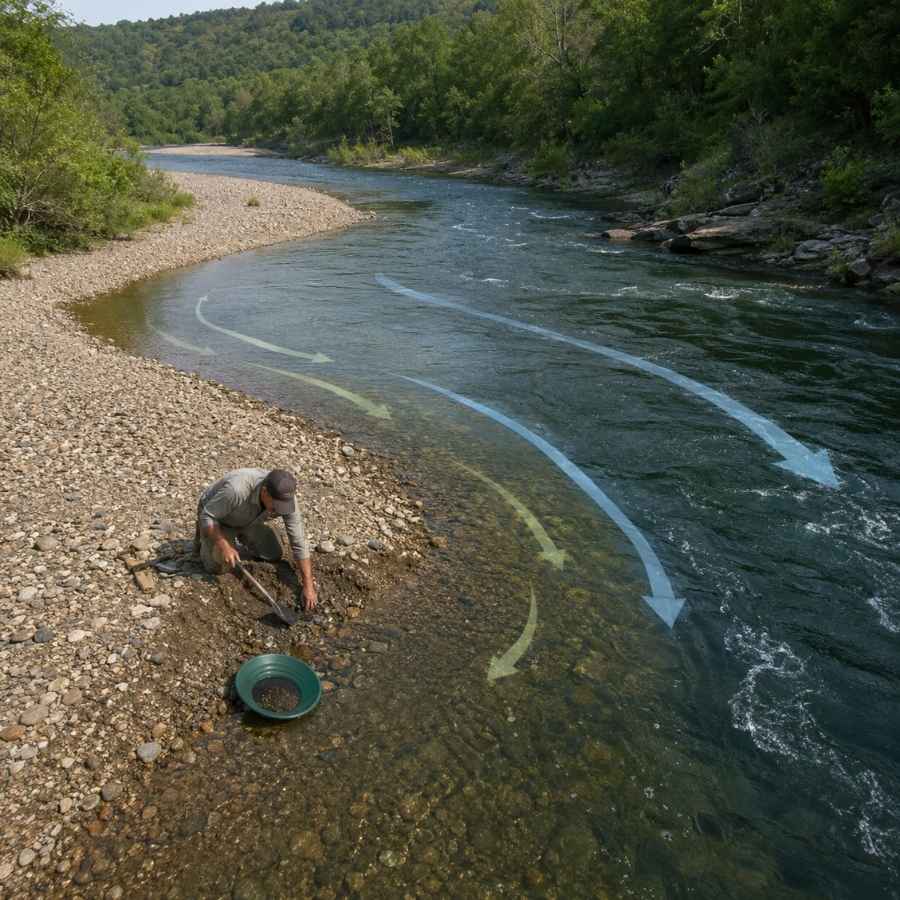
Water slows down on the inside of every curve, and slow water drops its gold. Look for the gravel bar that builds up on the inside of a bend and dig where the coarse gravel starts. In Oklahoma’s lazy southeastern rivers, inside bends are the most reliable producers.
Digging here means moving packed gravel, and a wide pan with deep riffles catches the fine gold as you work. The Garrett 15 Inch Dual Riffle SUPERSLUICE Gold Pan is built for exactly this kind of high volume panning.
Gravel Bars
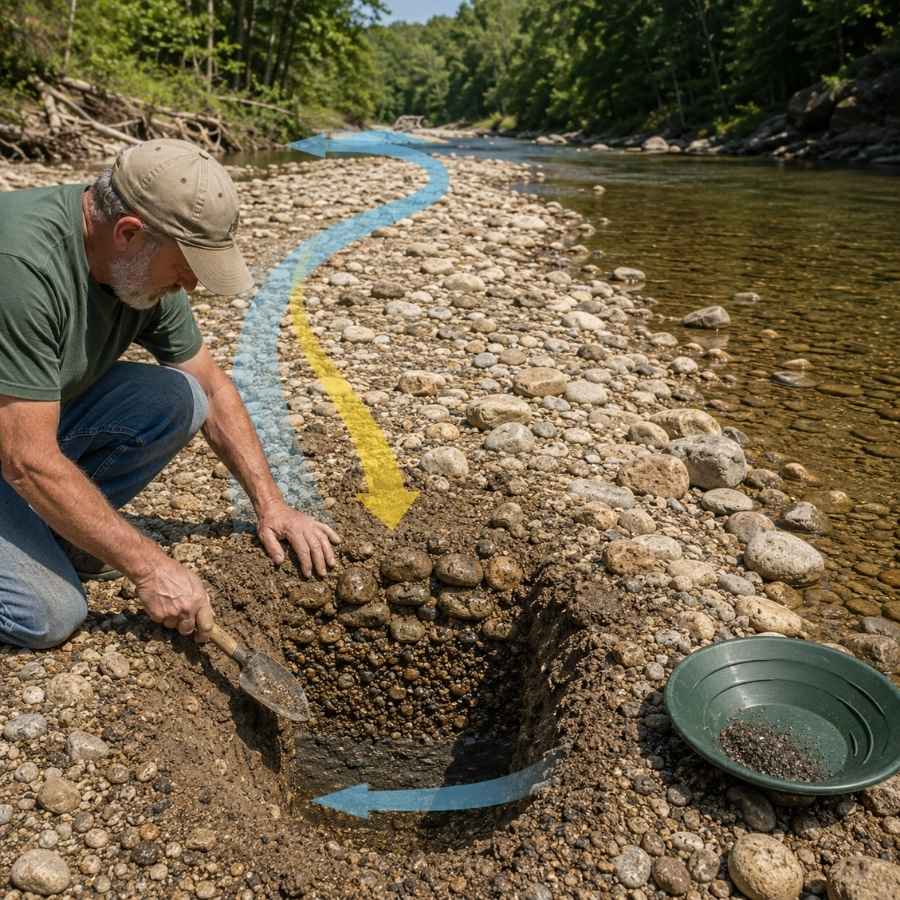
Summer low water exposes gravel bars that were underwater all spring. The gold in a bar concentrates at its upstream end and down at bedrock, not on the surface. Dig test holes and pan the bottom material.
Bars are full of oversized rock that wastes pan space. Screening it out first with the SE Half Inch Sifting Screen doubles the gravel you can actually process in a day.
Bedrock Cracks
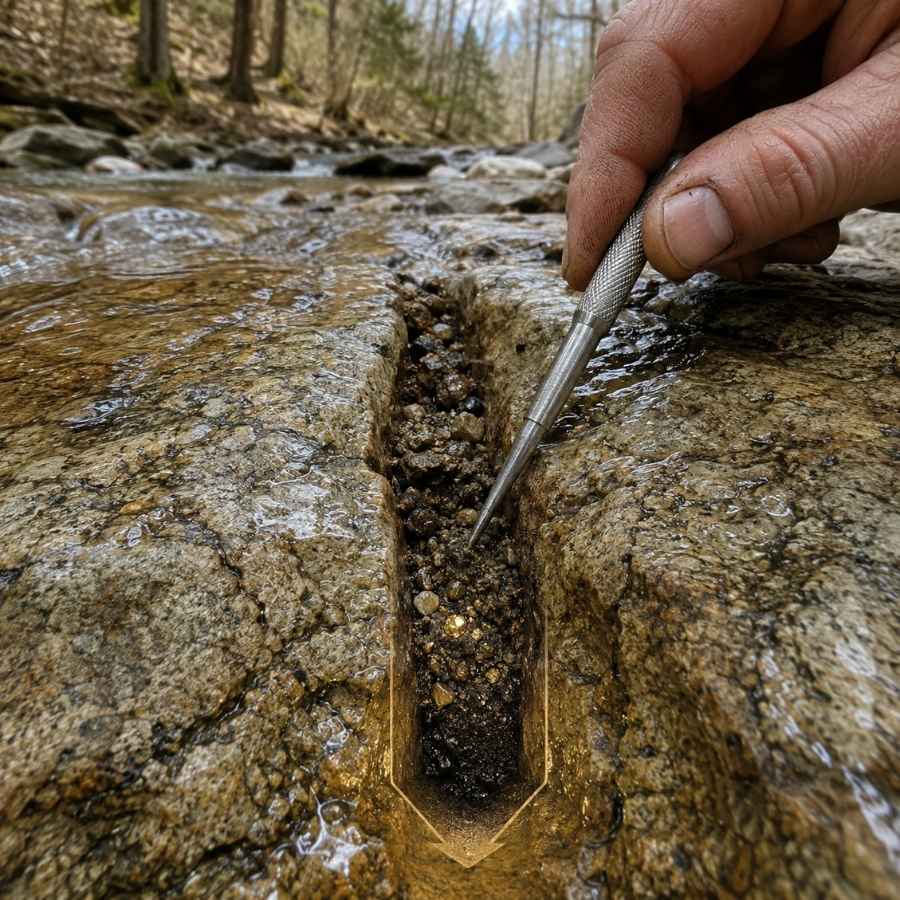
Bedrock is the floor gold cannot sink through, so its cracks fill up like nature’s own sluice box. Where any Oklahoma stream runs over exposed rock, every crack and crevice is a gold trap that has been collecting for centuries. Some of the best finds in the Ouachitas come from cleaning out cracks the size of your finger.
The dirt in the bottom inch is the richest material in the river. A steel crevice tool set like the ASR Outdoor Steel Crevice Tool Set scrapes out material your fingers cannot reach.
Behind Boulders
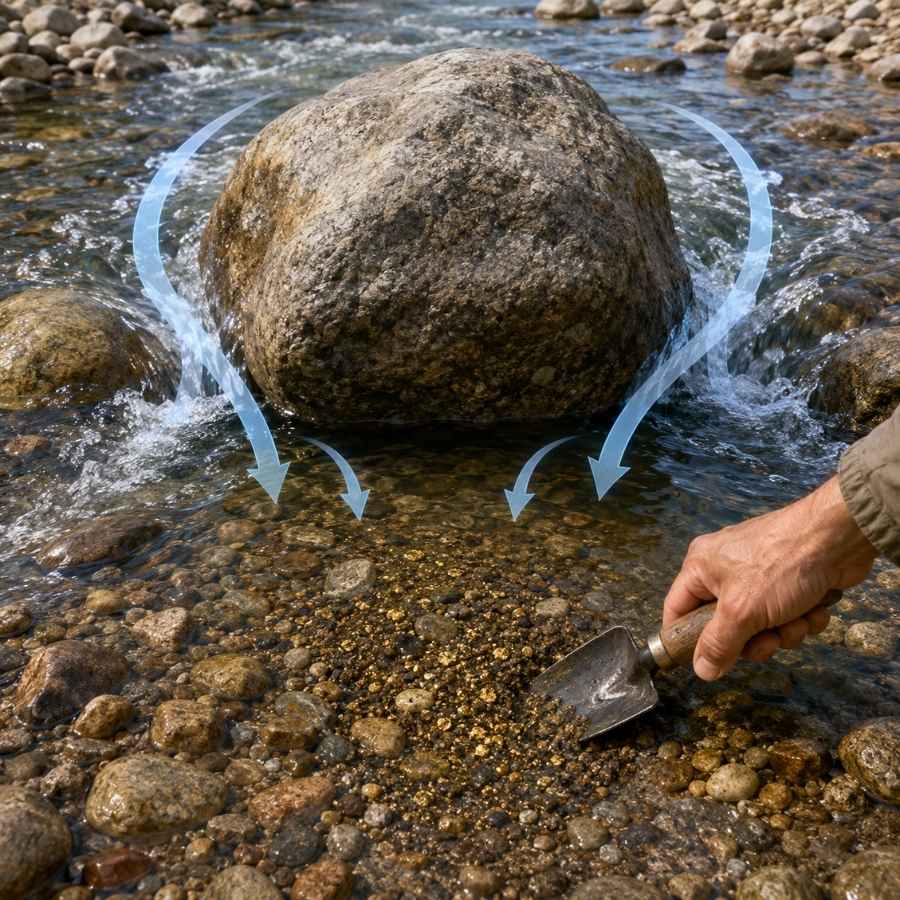
Every boulder splits the current and creates a calm pocket of slow water directly downstream. Gold traveling in a flood drops right into that pocket. Feel around the downstream base of big rocks and dig the packed gravel your fingers find there.
That gravel is usually cemented tight. A strong shovel like the Bully Tools 14 Gauge Round Point Shovel breaks it loose without snapping a handle mid trip.
Black Sand Streaks
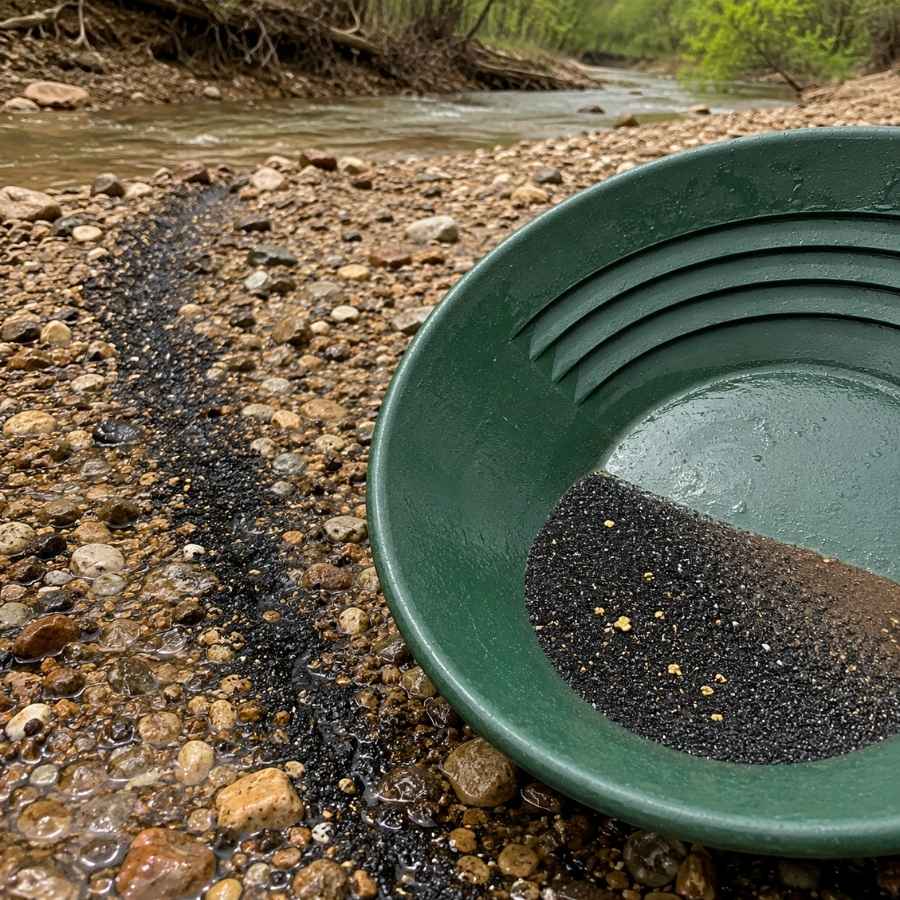
Black sand is crushed magnetite and hematite, and it is the number one gold indicator in Oklahoma. It is heavy, so it settles in the same spots gold does. When you see a dark streak in the gravel or a black layer in your pan, you are digging in the right place.
Separating fine gold from black sand at the end of the day is tedious by hand. A magnetic separator like the SE Magnetic Separator Pick Up Tool with Quick Release pulls the black sand out and leaves your gold behind in seconds.
Always Confirm Access and Collection Rules!
Before heading out to any of the locations on our list you need to confirm access requirements and collection rules for both public and private locations directly with the location. We haven’t personally verified every location and the access requirements and collection rules often change without notice.
Many of the locations we mention will not allow collecting but are still great places for those who love to find beautiful rocks and minerals in the wild without keeping them. We also can’t guarantee you will find anything in these locations since they are constantly changing.
Always get updated information directly from the source ahead of time to ensure responsible rockhounding. If you want even more current options it’s always a good idea to contact local rock and mineral clubs and groups
The Best Places To Find Gold in Oklahoma
Oklahoma’s gold splits into two main zones, the Ouachita Mountain rivers in the southeast and the old gold rush country creeks in the southwest, plus a couple of wildcard rivers elsewhere. Here is every spot worth your gas money, grouped by region.
Southeastern Oklahoma
The Ouachita Mountains along the Arkansas border are Oklahoma’s most reliable gold country. These forested ridges shed fine gold into every major river that drains them.
Kiamichi River

The Kiamichi is the most talked about gold river in Oklahoma, and prospectors still actively work it today. It rises in the Ouachita Mountains near the Arkansas line in LeFlore County and runs southwest through Pushmataha County, and its headwaters section is where the gold reports concentrate. Access is easiest at highway crossings and public bridge easements.
The gold is fine flour gold with occasional small flakes, and careful panning is the technique that works. Work the inside bends and pan down to the packed gravel.
Your pan will also turn up quartz pebbles, black sand, and the occasional garnet. This is exactly the moment people throw away good finds, because a wet unidentified stone looks like nothing. The US Rocks and Minerals Field Guide lets you check every odd stone against clear photos before it goes back in the river.
Bring the finish pan and snuffer bottle from the techniques section below.
Difficulty: 2 out of 5
Little River
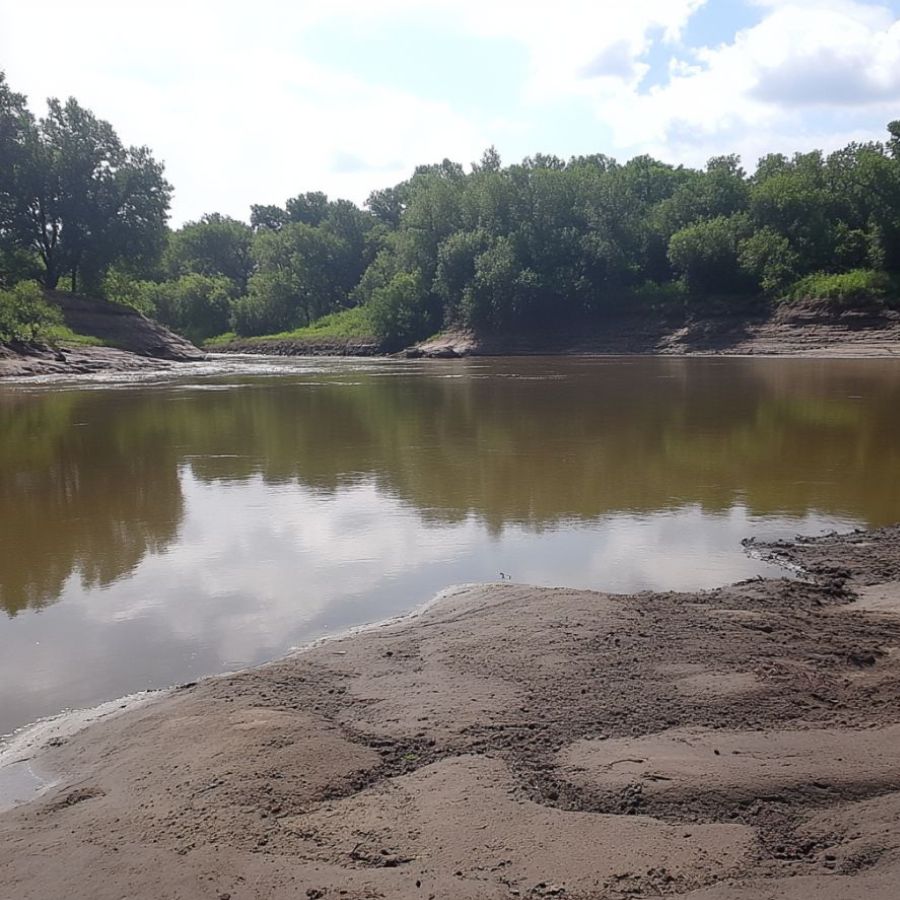
The Little River drains the southern Ouachitas through McCurtain County, and old reports place fine gold in its upper gravels. It is a quiet, wadable river with long gravel bars that reset with every spring flood. Most of the riverbank is private, so this is a spot where a polite knock on a farmhouse door opens real opportunities.
Flour gold is the find here, and gravel bar panning is the play. Dig the upstream ends of bars and pan the bottom material.
Bycatch includes jasper, chert, and petrified wood pieces washed from the surrounding hills. A classifier screen speeds up the gravel sorting, and you can grab the SE Half Inch Sifting Screen through the techniques section.
Difficulty: 3 out of 5
Glover River

The Glover is Oklahoma’s last major undammed river, which matters for gold hunters. No dam means floods still move fresh gravel every year, constantly restocking the bars and crevices with new material from the mountains. It runs through remote McCurtain County timber country north of Glover.
The gold is fine placer gold, and crevicing the exposed bedrock stretches is the standout technique. Summer low water opens up long runs of scoured rock.
You will also see quartz, black sand, and dark heavy pebbles of hematite in your pan. The access roads are gravel and rough after rain, so plan accordingly. A crevice tool set is the key gear here, linked in the techniques section.
Difficulty: 4 out of 5
Mountain Fork River

The Mountain Fork drains the same gold shedding mountains as the Glover and Little rivers, and its upper stretches above Broken Bow Lake carry the same fine gold. The lower river below the dam runs cold and clear through Beavers Bend State Park, where prospecting is limited to the park’s commercial guided panning operation. Work the upper river and its feeder creeks instead.
Flour gold in inside bends is the pattern, and standard panning works fine. The upper river gravel bars are wadable most of the summer.
Expect quartz and colorful chert in your pan alongside the black sand. Remember that the state park stretch is look but do not dig territory outside the paid operation.
Difficulty: 3 out of 5
Ouachita National Forest Creeks
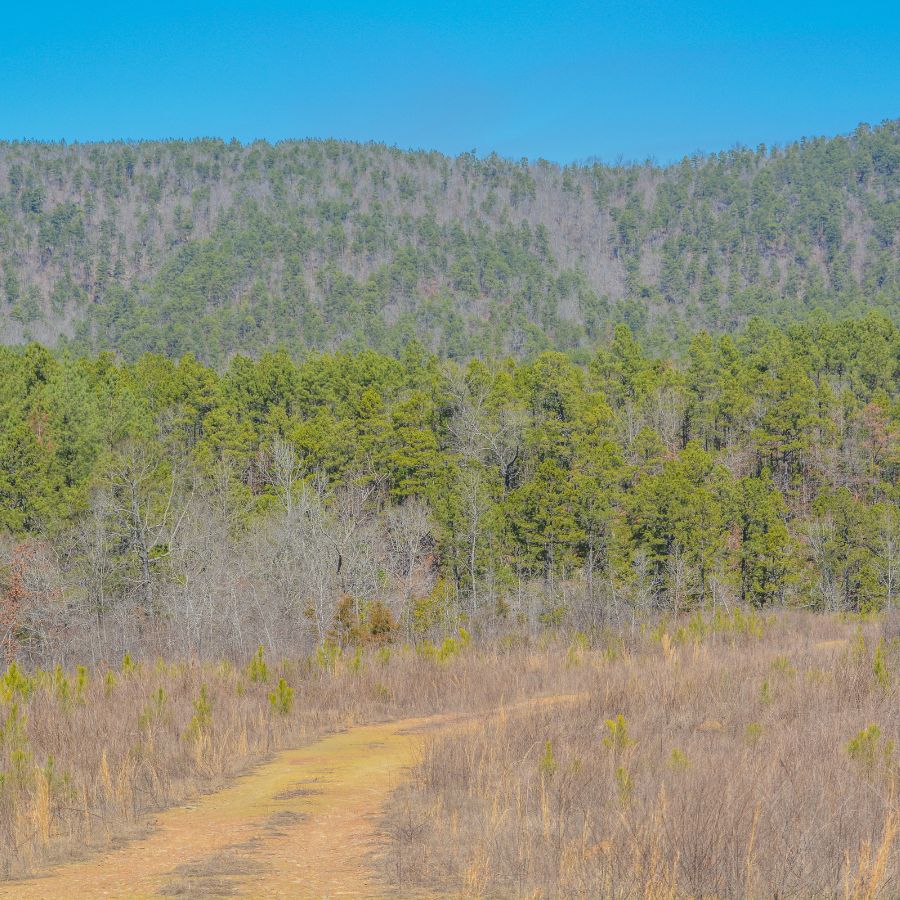
The Oklahoma side of the Ouachita National Forest in LeFlore and McCurtain counties is the legal bright spot in this whole guide. Recreational hand panning is generally allowed on National Forest land under casual use rules, no claim required, as long as you stick to hand tools and cause no real surface disturbance. The small creeks draining toward the Kiamichi and Mountain Fork are all worth testing.
Fine gold in bedrock cracks and behind boulders is what you are after. Pan the black sand streaks wherever a creek crosses rock.
Your pan will also show quartz, mica, and garnet sand. Confirm current rules with the Choctaw Ranger District before your trip, since casual use rules have limits. The full panning kit from the techniques section covers everything these creeks demand.
Difficulty: 3 out of 5
Southwestern Oklahoma
This is the old gold rush country around the Wichita Mountains. The mountains themselves are mostly off limits now, but the creeks draining them are a different story.
East and West Cache Creek

Cache Creek’s two branches drain the heart of the 1901 gold rush country through Comanche County. Every flood for the last century has carried fine gold out of those mountains and down these creeks. The stretches south of the wildlife refuge boundary, outside Fort Sill, are where prospectors focus.
Flour gold is the find, concentrated in inside bends and behind boulders. Panning and small scale crevicing both work.
The pan also turns up feldspar, quartz, and occasionally tiny zircons weathered from the granite. Nearly all of this land is private ranch country, so permission is essential. Standard panning gear from the techniques section is all you need.
Difficulty: 3 out of 5
Otter Creek
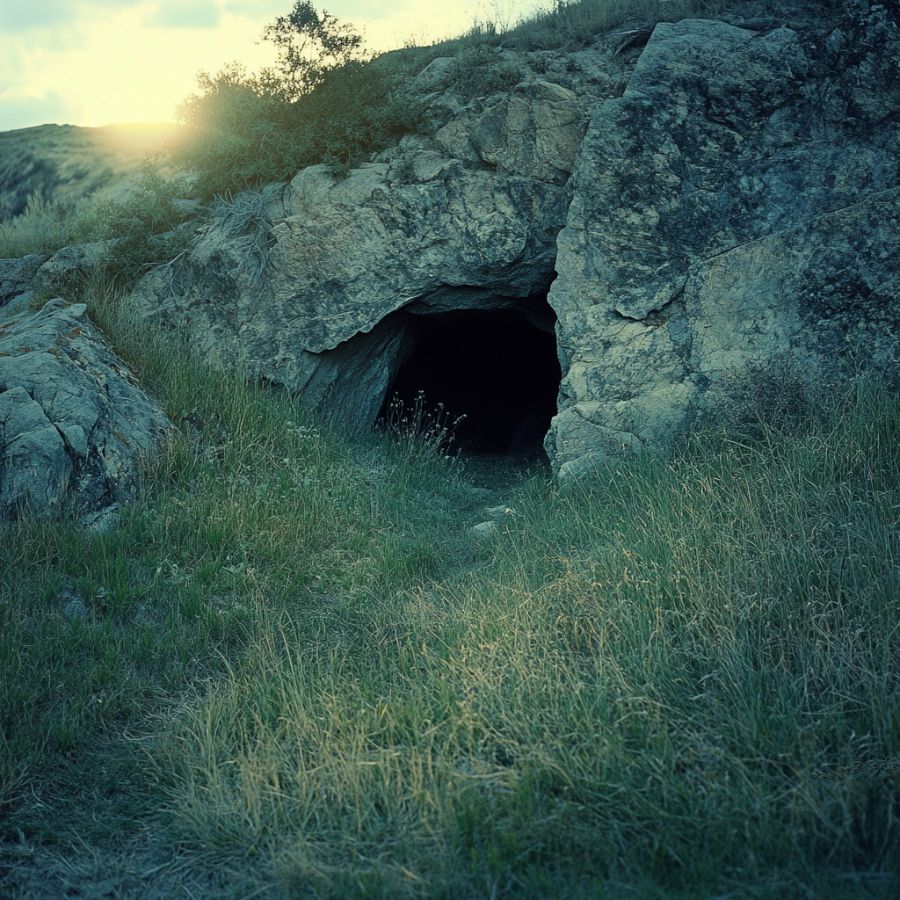
Otter Creek drains the western end of the Wichitas through Kiowa and Tillman counties, passing the old mining camps near Roosevelt. Historic reports put fine placer gold in its middle and upper stretches. Tom Steed Reservoir interrupts the creek, and the flowing sections above and below it are the prospecting water.
Fine gold with black sand is the standard find, and panning the inside bends is the technique. Low water in late summer exposes the best gravel.
Granite pebbles, feldspar, and magnetite ride along in every pan. Access is a mix of private land and public water easements, so do your homework parcel by parcel. A magnetic separator makes the black sand here manageable, linked in the techniques section.
Difficulty: 3 out of 5
Central Oklahoma
North Canadian River

The North Canadian brings gold panning right to central Oklahoma’s doorstep. Old accounts describe traces of ultra fine flour gold in its sands, and its watershed reaches far to the west. The wide sandy bed near Oklahoma City makes it the most accessible river on this list, and an easy afternoon here builds the fine gold skills that pay off statewide.
Ultra fine flour gold is the prize here, and a finish pan with slow careful technique is how you catch every speck. Pan the black sand streaks on the downstream ends of sand bars.
The sand also carries magnetite, garnet dust, and occasional petrified wood chips. The wide sand flats make it a fun, safe spot for a family gold day. Bring the finish pan from the techniques section.
Difficulty: 2 out of 5
Northeastern Oklahoma
Illinois River

The Illinois runs clear and gravelly through Cherokee County near Tahlequah, draining the Ozark foothills. Prospectors keep reporting ultra fine colors in the black sand of its famous gravel bars. Float traffic is heavy in summer, so prospect on weekday mornings or in the off season.
Fine flour gold in gravel bar black sands is the target, and panning is the technique. The upstream ends of bars after winter floods are the best bet.
The gravel is loaded with chert, the occasional agate, and Ozark quartz. Public access points along the designated scenic river corridor make this the easiest legal access in the northeast. Standard panning gear from the techniques section covers it.
Difficulty: 2 out of 5
More Proven Places To Find Gold in Oklahoma
The nine spots above are the headliners, but Oklahoma’s gold country holds more water worth your pan. The creeks and rivers below carry the same fine gold from the same mountains, backed by old reports and steady word from the prospecting community. Rules and access change often, so confirm both with the landowner or managing agency before you visit any of them.

Southeastern Oklahoma
Fourche Maline Creek (Latimer and LeFlore Counties). The Fourche Maline drains the northern Ouachita ridges toward Lake Wister, and prospecting guides list its mountain sourced gravels as worth testing for fine gold. Work the inside bends and black sand streaks the same way you would on the Kiamichi. Part of the creek passes through Robbers Cave State Park where collecting is banned, so stay outside park boundaries and get landowner permission elsewhere.
Honobia Creek (LeFlore and Pushmataha Counties). Honobia Creek feeds the Little River from the same Kiamichi range ridges that supply the proven rivers in this guide, and prospectors test its gravel bars for the same fine flour gold. It flows through the Honobia Creek Wildlife Management Area, where you need a land access permit from the Wildlife Department. Check current WMA rules before you dig, since this is leased timber company land with its own restrictions.
Poteau River Headwater Creeks (LeFlore County). The small creeks feeding the upper Poteau River come straight off the Ouachita ridges, and prospecting guides report that their mountain sourced gravels can carry fine gold. Some stretches run close to Ouachita National Forest land where casual hand panning is generally allowed. Confirm the exact boundary with the ranger district, because forest land and private land trade off quickly here.
Eagle Fork Creek (McCurtain County). Eagle Fork drains the high Ouachita country near Smithville and joins the Mountain Fork upstream of Broken Bow Lake, so it moves the same mountain gravel as the proven river below it. Prospectors report fine colors in its bars after spring floods reset them. Most of the creek runs through private timber and ranch land, so ask permission before you wade in.
Southwestern Oklahoma

Medicine Creek at Meers (Comanche County). Meers was a genuine 1901 gold rush camp, and Medicine Creek runs right through the old mining ground below the town site. Fine gold washing out of those historic diggings is what prospectors look for in its gravel today. The land here is private ranch country pressed against the wildlife refuge boundary, so permission is essential and the refuge itself stays completely off limits.
Red River Gravel Bars (Cotton and Jefferson Counties). Everything the Wichitas shed eventually funnels down Cache Creek and into the Red River, and prospectors report ultra fine flour gold in the big river’s sand bars. Treat it like the North Canadian, a finish pan spot where careful technique on black sand streaks brings out the color. The riverbed along the Texas border has a tangled ownership history, so check locally and get clear permission before you dig.
North Fork of the Red River (Greer and Jackson Counties). The North Fork drains the far western end of the Wichita Mountains past Quartz Mountain, and prospecting references consistently report that it has produced fine placer color. Pan the black sand streaks on inside bends when summer low water exposes the bars. Nearly all of the riverbank is private, so a landowner conversation comes before any digging.
The Best Gold Hunting Techniques in Oklahoma
Oklahoma’s fine gold rewards patient technique over expensive machinery. These are the three methods that actually put Oklahoma gold in a vial, ordered from easiest to hardest.
Gold Panning (Difficulty: 1 out of 5)
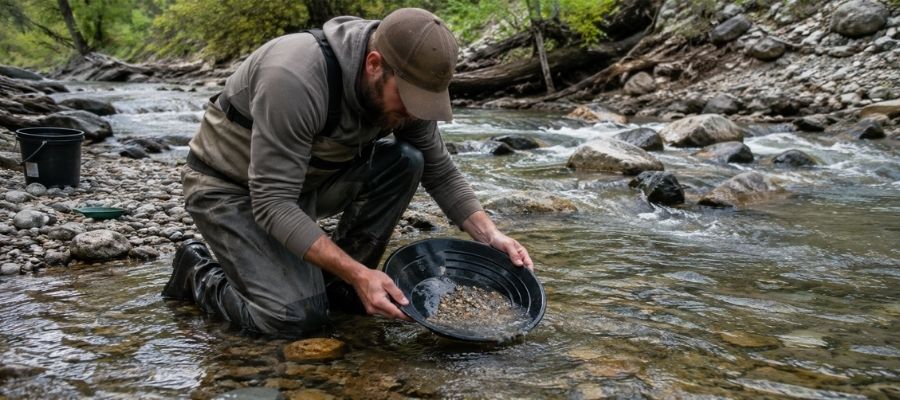
Panning is the whole game in Oklahoma. Fill your pan with gravel, submerge it, shake hard so the heavy gold sinks, then tilt and swirl the light material off the top until only the heavy concentrate line remains. With flour gold this fine, finish each pan slowly, because one careless swirl sends a day of gold back into the river.
It works everywhere in this guide, and it is the only method you need at the Ouachita National Forest creeks and the Kiamichi.
Essential Tools:
- Deep riffle gold pan: Garrett 15 Inch Dual Riffle SUPERSLUICE Gold Pan
- Finish pan: Garrett Prospecting 10 Inch Backpacker Gold Pan
- Snuffer bottle: Garrett Gold Guzzler Bottle
- Storage vials: SE Glass Vials with Caps
Crevicing (Difficulty: 2 out of 5)
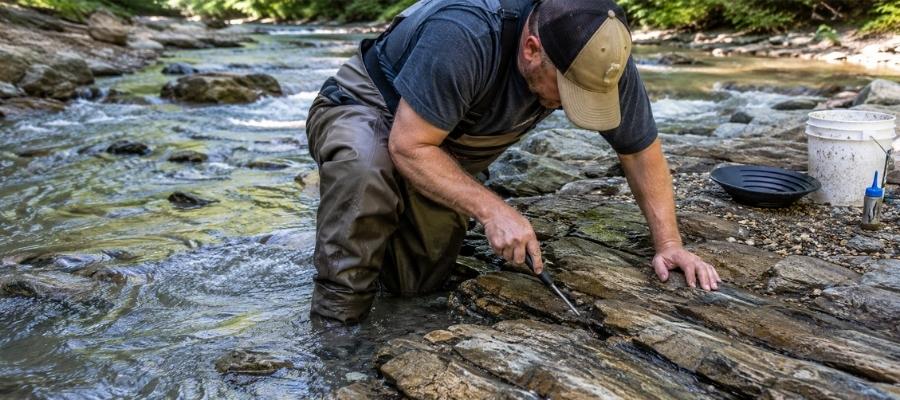
Crevicing means cleaning out the cracks in exposed bedrock and panning what you scrape loose. It is slow, surgical, and it produces some of the best gold in the state because bedrock cracks have been trapping gold for thousands of years. The Glover River’s scoured rock runs are Oklahoma’s crevicing headquarters.
Work every crack down to its very bottom, because the last spoonful of packed dirt holds most of the gold.
Essential Tools:
- Crevice tool set: ASR Outdoor Steel Crevice Tool Set
- Hand trowel: Edward Tools Bend Proof Trowel
- Finish pan: linked in the panning list above
- Magnifying loupe: JARLINK 30X 60X Illuminated Loupe
Sluicing (Difficulty: 3 out of 5)
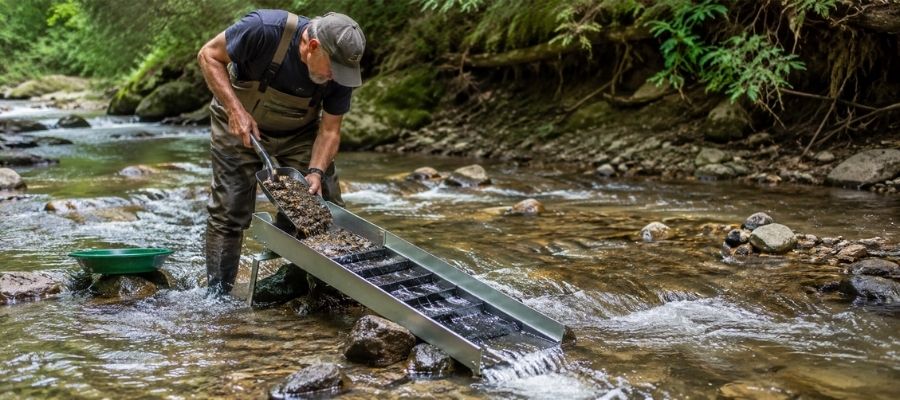
A hand sluice is a small channel with riffles that you set in the current, then feed with gravel while the river does the panning for you. It processes ten times what a pan can, which matters when the gold runs this fine. Check the legal section first, because sluices are restricted on some public land even when hand panning is fine.
In Oklahoma a sluice earns its keep on the bigger southeastern rivers, where gravel is deep and water flow is steady.
Essential Tools:
- Hand sluice: Keene A52 Hand Sluice
- Digging shovel: Bully Tools 14 Gauge Round Point Shovel
- Classifier screen: SE Half Inch Sifting Screen
- Black sand magnet: SE Magnetic Separator Pick Up Tool with Quick Release
How To Tell Real Gold From Fool’s Gold
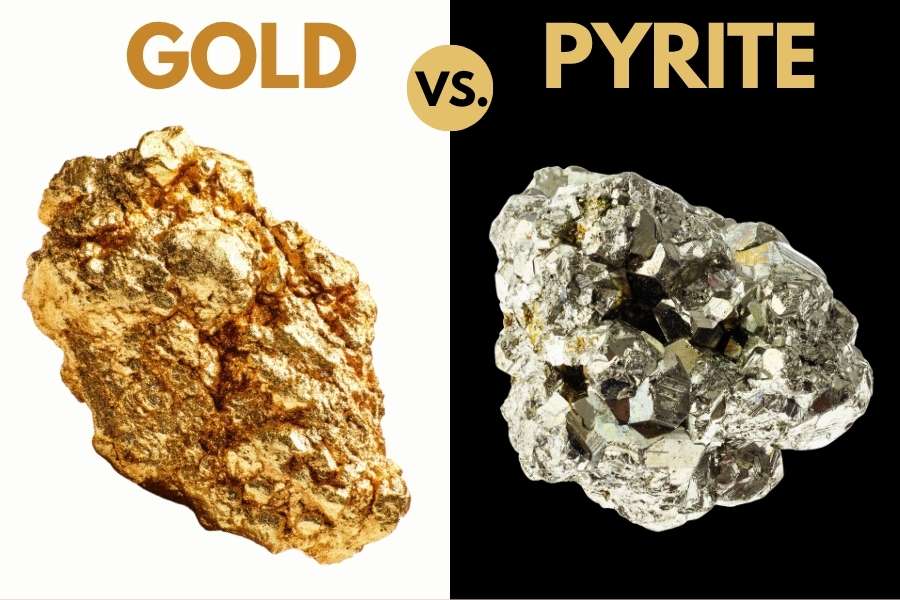
Here is the skill that pays off on every Oklahoma trip. The state’s streams carry plenty of shiny pyrite, mica, and chalcopyrite alongside the gold, and knowing the difference on sight keeps every celebration a real one. Two quick tests sort them out every time.
The shadow test takes one second. Shade your pan with your hand and watch the sparkle. Real gold stays rich and golden in shadow, while pyrite and mica go gray and lifeless the instant the direct light leaves them.
The poke test settles anything the shadow test misses. Press a pin firmly into the particle. Gold is soft metal, so it dents and holds the mark. Pyrite is brittle and shatters, and mica just slides apart in sheets.
The reason to get this right is not avoiding embarrassment. It is that people who cannot tell the difference eventually toss a pan that had real gold in it. The US Rocks and Minerals Field Guide is the insurance policy, with side by side photos of gold and every one of its imitators, printed on waterproof pages you can hold right over your wet pan.

How Gold Got Into Oklahoma
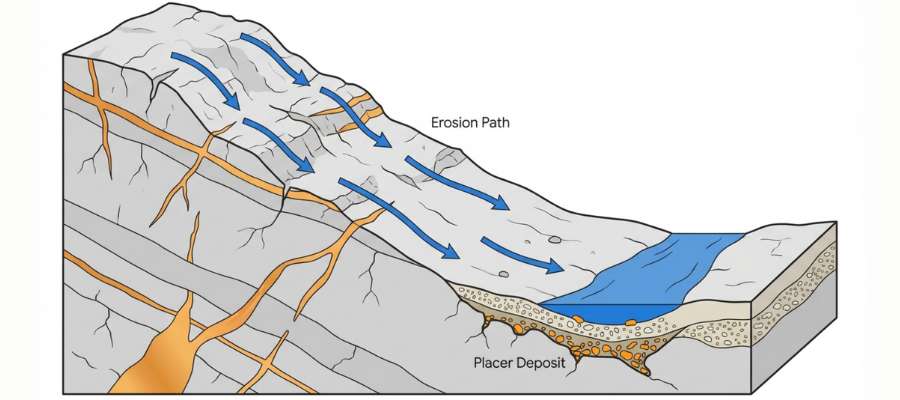
Every spot in this guide sits where it sits because of two ancient mountain building events. Understanding them tells you why Oklahoma gold is fine, and why it concentrates where it does.
About 300 million years ago, a continental collision crumpled deep ocean sediments into the Ouachita Mountains. Hot fluids moving through those folded rocks left behind quartz veins, and some of those veins carry traces of gold. Ever since, rain and rivers have been grinding those veins apart and washing the freed gold down into the Kiamichi, Little, Glover, and Mountain Fork valleys.
The Wichita Mountains are far older, the roots of volcanic activity from around 525 million years ago. Their granites and rhyolites carry scattered mineralized zones, which is what the 1901 gold rush was chasing. The veins were real, and erosion has been sprinkling their fine gold into Cache and Otter creeks for millions of years.
One myth needs killing here. You may read that glaciers dropped Oklahoma’s gold, but the ice age glaciers never reached Oklahoma. Every flake in these rivers is homegrown mountain gold, ground fine by water and time.
What To Bring for an Oklahoma Gold Day Trip

Here is the full checklist. Screenshot this section before you lose cell service in the Ouachitas.
- Gold pans and snuffer bottle, covered in the techniques section
- Crevice tools and trowel, same place
- Classifier screen and vials
- Rubber boots or wading shoes with real tread
- Drinking water, more than you think, Oklahoma summers are serious
- Sunscreen and a brimmed hat
- Printed landowner permission or the ranger district phone number
- Snacks and a dry change of clothes
If you are starting from zero, one box solves it. The Garrett Deluxe Gold Pan Kit has the pans, classifier, snuffer, and vials in one purchase, and it is the kit we hand to every beginner who joins us.
The Best Time of Year To Hunt for Gold in Oklahoma
Timing an Oklahoma gold trip is about water levels and heat. Here is the calendar, region by region.
Southeastern Oklahoma
Late summer through fall is prime time in the Ouachita rivers. Water drops to its lowest levels, exposing gravel bars and bedrock runs that are unreachable in spring. The bonus window is right after the first spring floods recede, when fresh gold has just been redeposited.
Avoid the big rivers during spring high water. The Glover especially runs fast and dangerous after storms.
Southwestern Oklahoma

Fall through spring is the window for Cache and Otter creeks. Summer heat regularly passes 100 degrees out here with almost no shade along the creeks. Cooler months also mean lower, clearer water for reading the gravel.
Winter panning is downright pleasant here on sunny days. Just check creek levels after rain.
Central Oklahoma
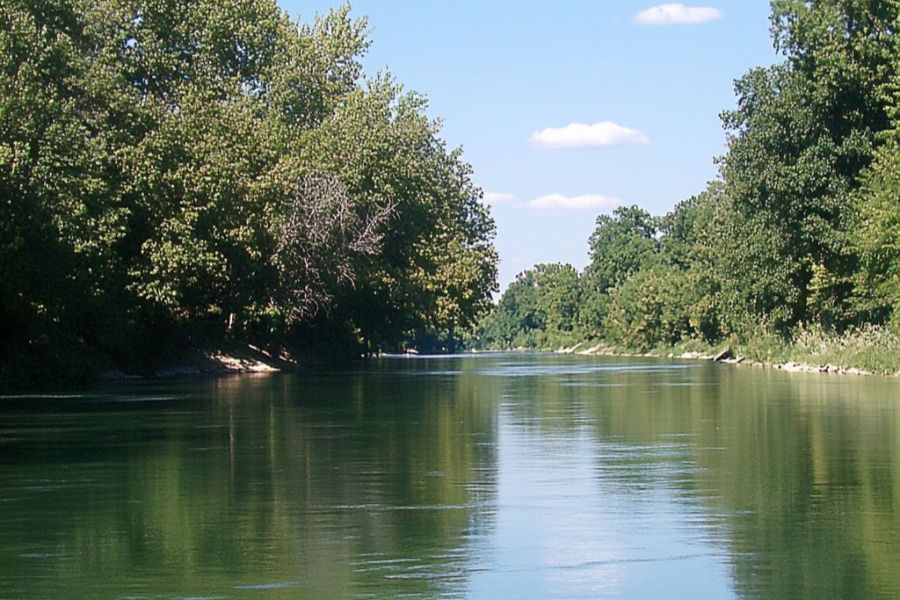
The North Canadian fishes best for gold in late summer and early fall, when the sandy bed is mostly exposed. Wide sand flats make for easy, safe family trips in September and October.
Skip it after heavy rain, when the river spreads across its whole bed and the black sand streaks vanish.
Northeastern Oklahoma
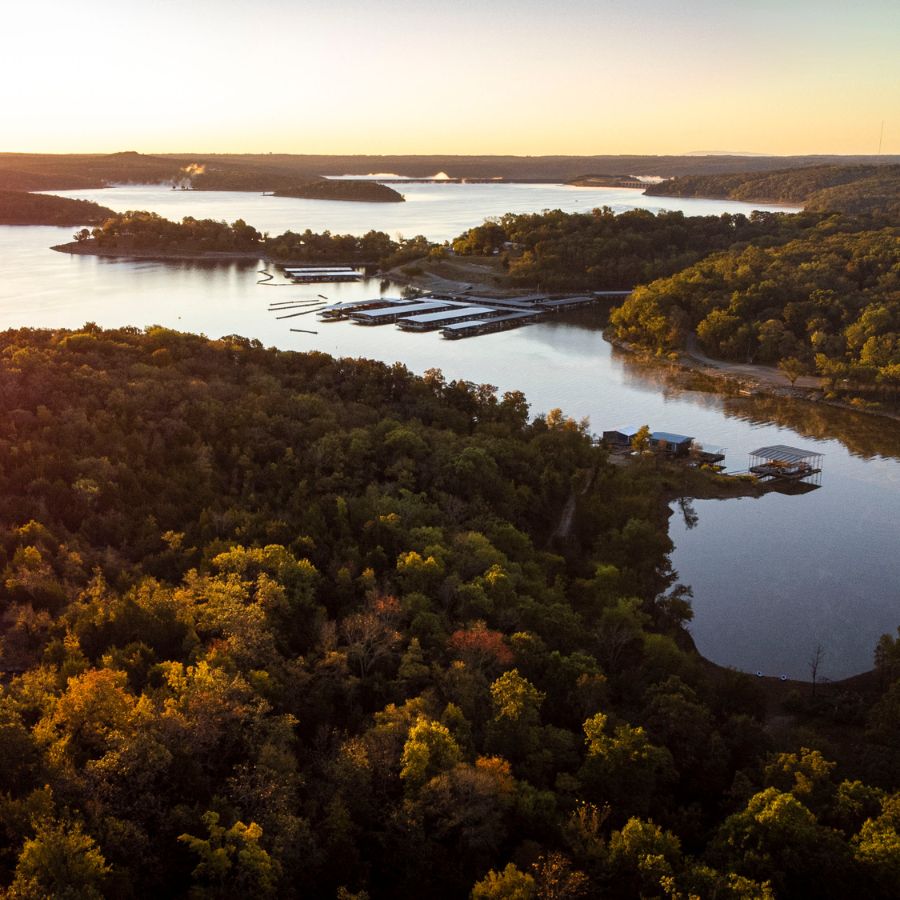
Fall and winter are the Illinois River’s quiet season, after the float trip crowds disappear. Low clear water exposes the gravel bars, and weekday mornings feel like a private river.
Spring works too if you go midweek. Summer weekends are wall to wall kayaks, and prospecting the busy stretches is not worth the hassle.
Other Valuable Rocks and Minerals You Can Find in Oklahoma
The same dirt that hides Oklahoma’s gold is loaded with other treasure, and some of it is worth more than the gold. Keep an eye out for all of these while your pan is working.
Rose Rocks
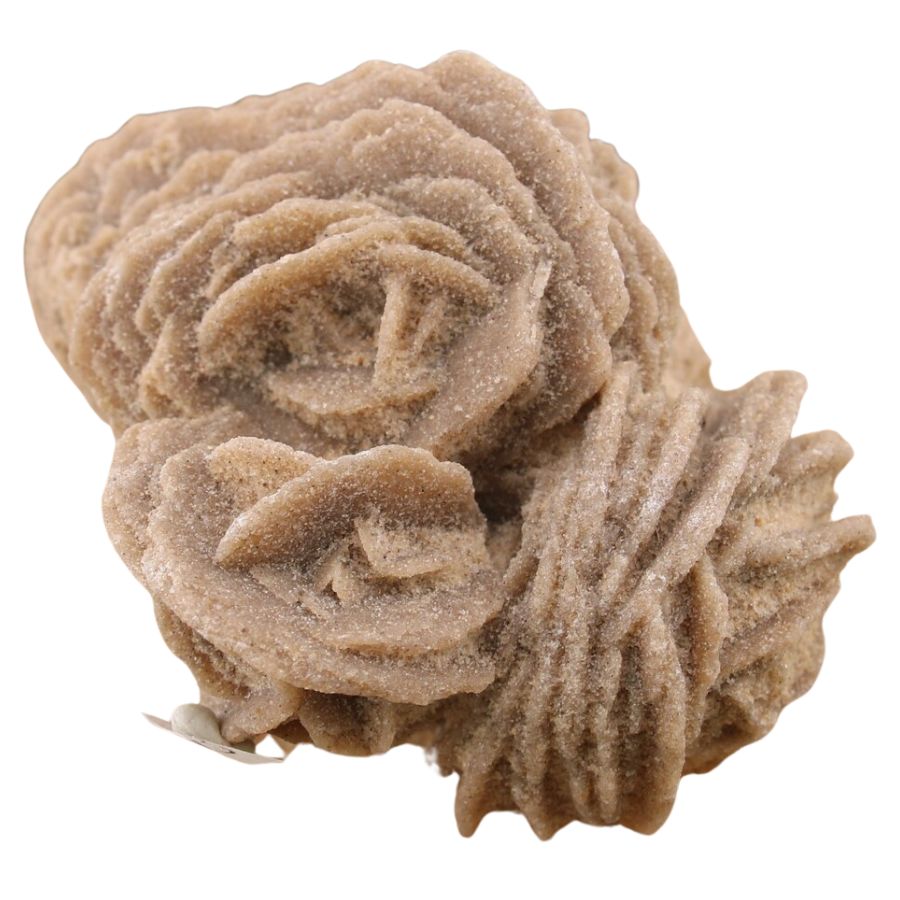
Rose rocks are barite crystals that grow in the shape of a blooming rose, and Oklahoma is the world capital for them. They form in the red sandstone belt through central Oklahoma. Our full guide to Oklahoma crystals shows exactly where to dig them.
Hourglass Selenite
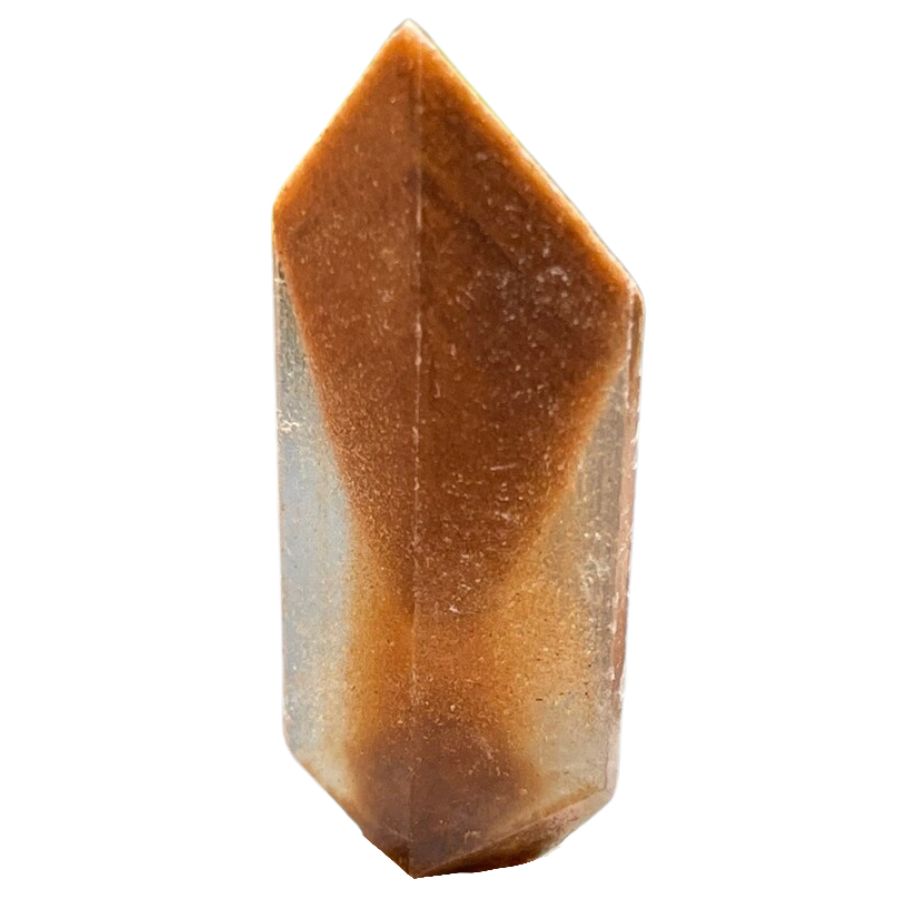
Hourglass selenite crystals grow with a perfect amber hourglass shape trapped inside, and they are found nowhere else on Earth except Oklahoma’s Great Salt Plains. You can dig them yourself in season. They headline our guide to gem hunting in Oklahoma.
Quartz

Quartz rides along in every gold pan in the Ouachitas, and clear crystal points wash out of the same veins that carry the gold. Check any white pebble with flat shiny faces. Our Oklahoma rockhounding guide lists the best quartz spots in the state.
Agate
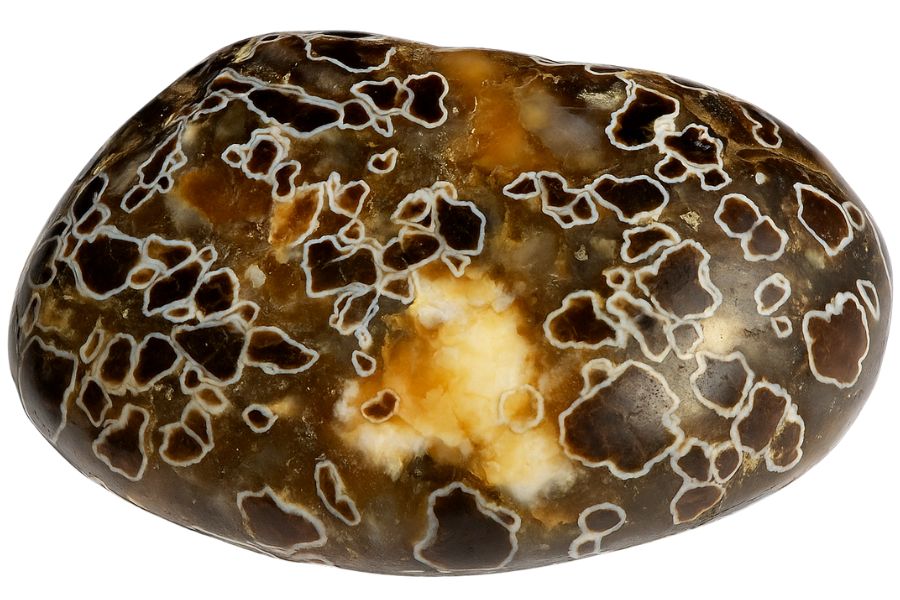
Oklahoma agates turn up in gravel bars statewide, with the banded Boley agate as the local prize. Wet agate glows with translucent bands that dry rock hides. Here is our full guide to finding agates in Oklahoma.
Pyrite
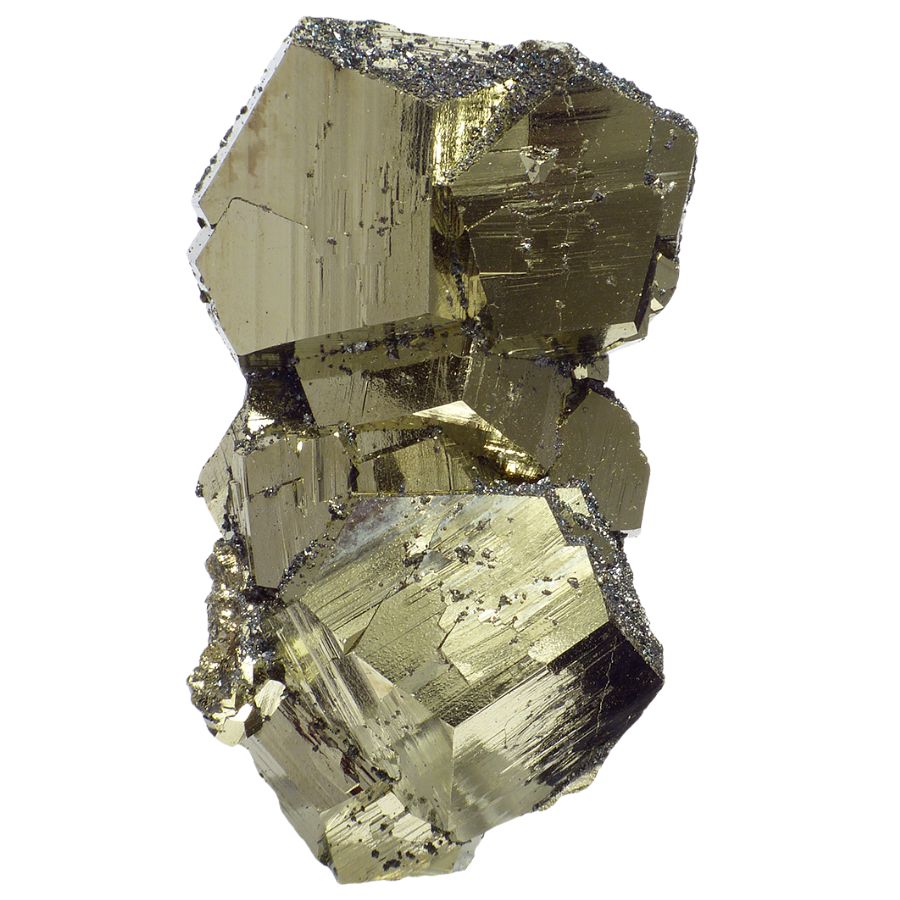
Yes, fool’s gold is worth keeping when it forms sharp brassy cubes. Good pyrite crystal clusters sell to collectors and look fantastic on a shelf. You will pan up plenty in the Wichita drainage creeks.
Chalcopyrite
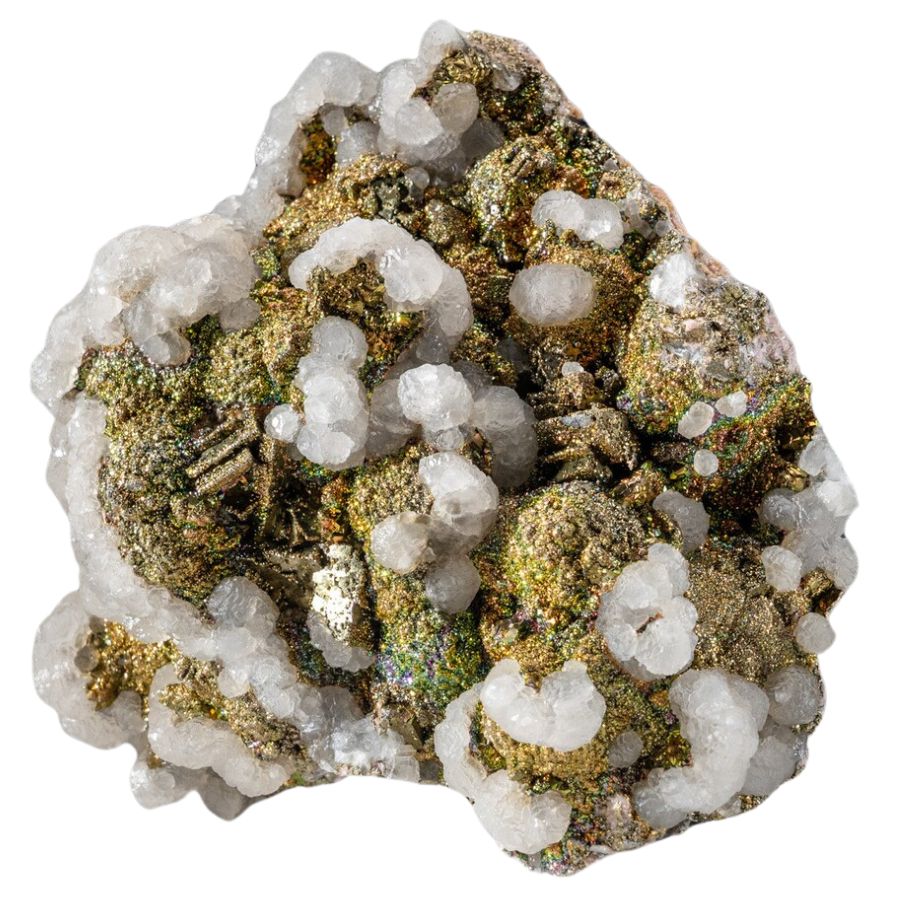
Chalcopyrite is pyrite’s coppery cousin, and it tarnishes into wild peacock blues and purples. It shows up in the same southeastern gravels as the gold. Weathered pieces with rainbow tarnish are keepers.
Galena
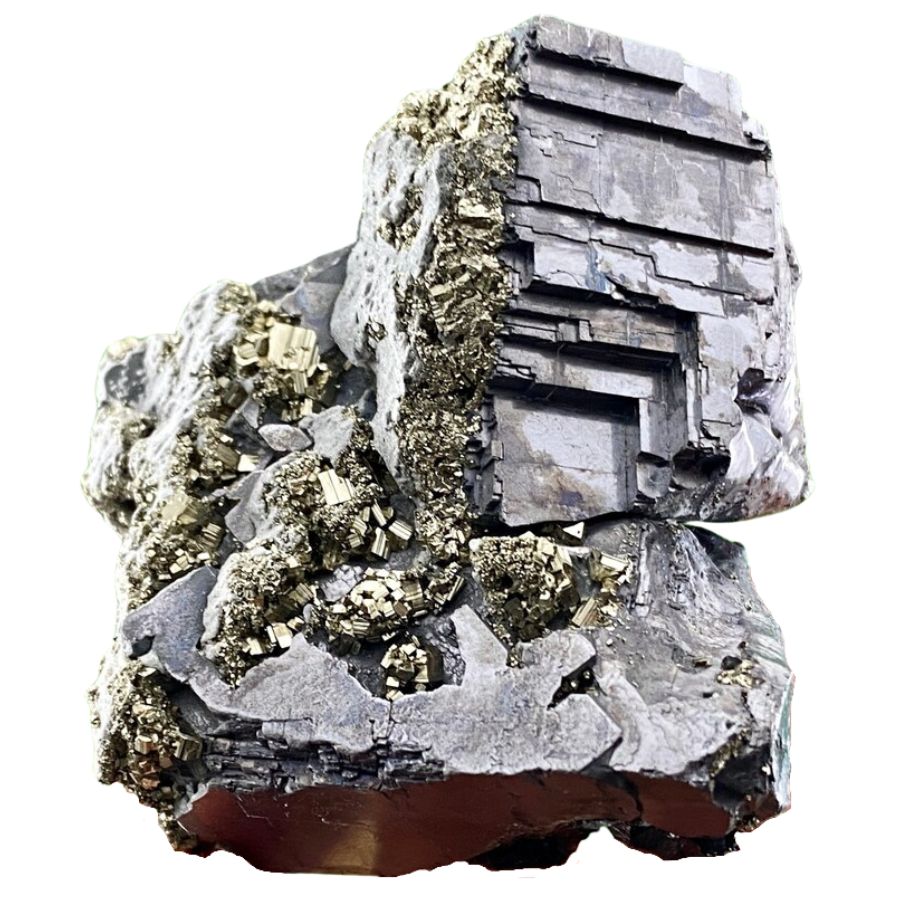
Galena is lead ore that forms heavy, mirror bright silver cubes. Northeastern Oklahoma sits on the edge of the old Tri State mining district, and galena still turns up in that corner’s gravels. Its weight fools people into thinking they found something even better.
Calcite
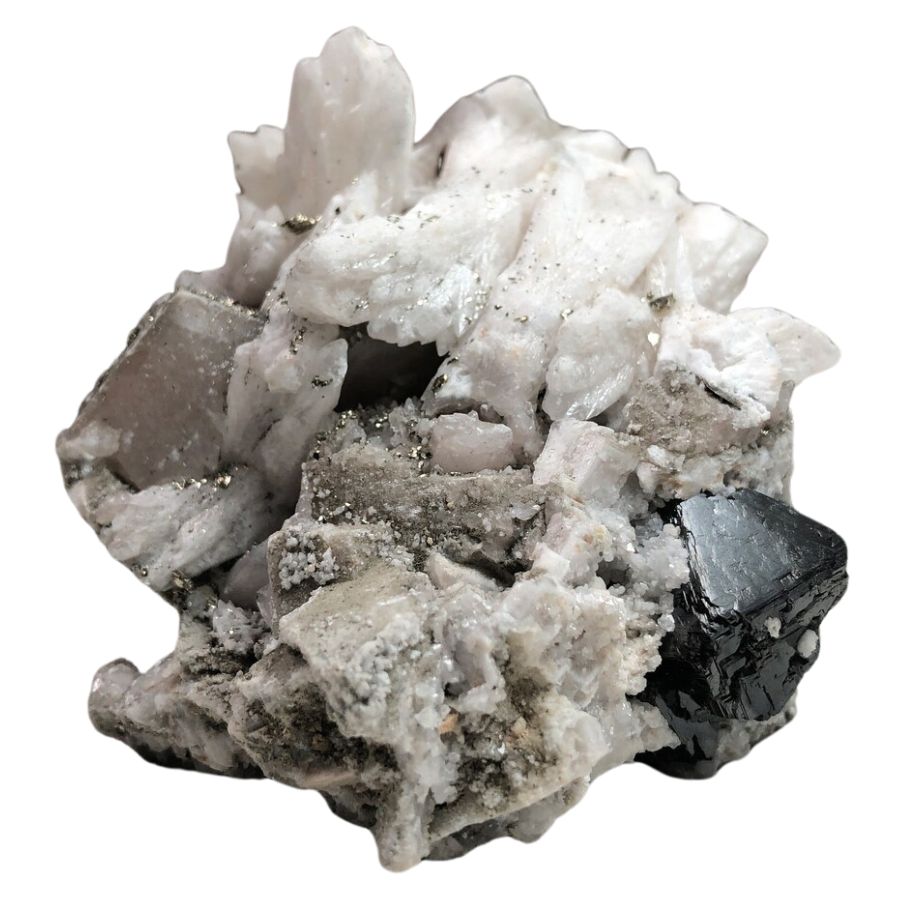
Calcite crystals line cavities and geodes across Oklahoma’s limestone country. Clear golden calcite points are the ones collectors chase. Our guide to Oklahoma geodes covers the best cavity hunting spots.
Hematite
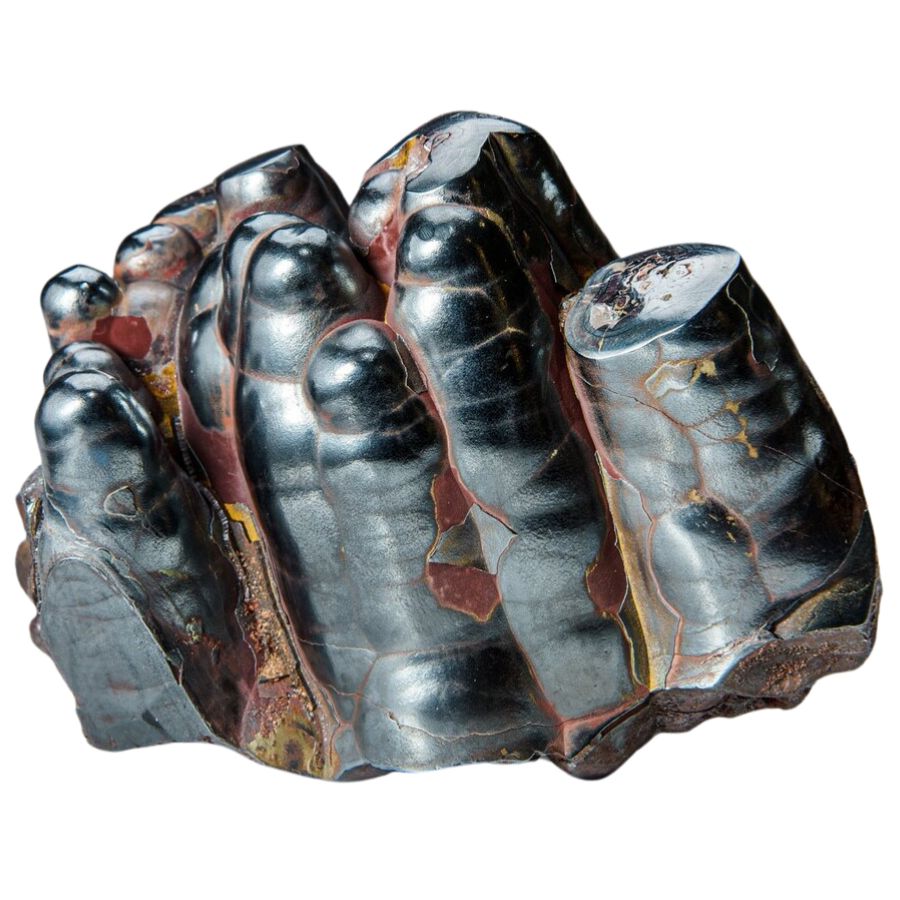
Hematite is the iron mineral behind Oklahoma’s red dirt, and heavy silver black chunks of it collect in the same pan corner as your gold. Polished hematite has been jewelry material for centuries. Big clean pieces are worth pocketing.
Celestine
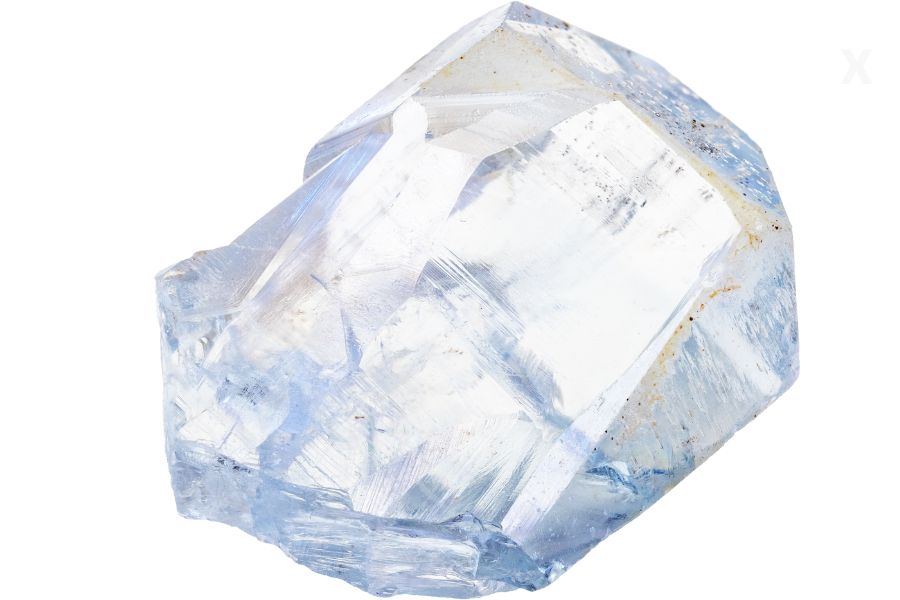
Celestine forms delicate sky blue crystals in Oklahoma’s gypsum country. It is soft and fragile, which makes clean crystals prized by collectors. Our overview of Oklahoma rocks, minerals, and gems shows what else the gypsum hills hide.
Here is the thing about every mineral on this list. In a wet pan, half of them look like gray or white pebbles, and people flick real treasure back into the river every single weekend. The US Rocks and Minerals Field Guide exists so that never happens to you, with photo identification for 140 rocks and minerals you can check streamside in seconds.

Legal Rules for Gold Prospecting in Oklahoma

Before you touch a pan to gravel, read this section. We are rockhounds, not lawyers, and nothing here is legal advice. Rules change, and staying legal is entirely your responsibility.
Private Property
Most gold bearing water in Oklahoma flows through private land, and in Oklahoma landowners generally control the streambeds too. That makes written permission the single most important tool you can carry. In our experience, rural landowners often say yes to a polite ask, especially when you offer to show them anything you find.
Protected and Restricted Land
The Wichita Mountains Wildlife Refuge bans prospecting completely, including metal detecting and removing any rock or mineral, and enforcement is real. State parks prohibit collecting too, with Beavers Bend’s paid panning operation as the family friendly exception. The bright spot is the Ouachita National Forest, where casual hand panning is generally allowed, confirmed through the Choctaw Ranger District.
Equipment Restrictions
Hand pans and hand tools are the safe baseline everywhere panning is legal. Suction dredges and other motorized equipment need authorization on National Forest land and can trigger state water quality rules elsewhere. Oklahoma has no BLM land open to casual mining claims, so claim staking is not part of the picture here.
Play it safe on every trip. Confirm access directly with the landowner or the managing agency before you dig, because boundaries and rules change without notice.
Some locations in this guide sit on land where collecting is limited or seasonal. When in doubt, treat a spot as look but do not take until you have confirmation in hand.
The best shortcut is local knowledge. Oklahoma’s rock and mineral clubs know which landowners welcome prospectors and which stretches are open, and a club membership pays for itself in access alone.
Oklahoma Gold FAQ
Is there gold in Oklahoma?
Yes, there is gold in Oklahoma, and bright fine placer gold is the classic find. The best documented areas are the Ouachita Mountain rivers in the southeast and the creeks draining the Wichita Mountains in the southwest. Hobby panners keep finding color in both regions today.
Where can I pan for gold in Oklahoma?
The Kiamichi River, Glover River, and the creeks of the Ouachita National Forest are the most popular legal options in the southeast. East Cache Creek and Otter Creek carry fine gold in the southwest with landowner permission. The best places section above breaks down access for every spot.
Is it illegal to pan for gold in Oklahoma?
Panning is legal in Oklahoma with the right permissions, and illegal without them. You need landowner permission on private land, and prospecting is banned in the Wichita Mountains Wildlife Refuge and most state parks. Casual hand panning is generally allowed in the Ouachita National Forest.
Has anyone ever found gold in Oklahoma?
Yes. Spanish miners worked the Wichita Mountains as early as 1765, and the 1901 gold rush filed over 2,000 claims there. Modern prospectors regularly recover fine flour gold from southeastern rivers, and spring floods restock those gravels every year.
What rivers in Oklahoma have gold?
The Kiamichi, Little, Glover, and Mountain Fork rivers in southeastern Oklahoma all carry fine placer gold. East Cache Creek and Otter Creek drain the old gold rush country in the southwest. Prospectors also report ultra fine gold in the North Canadian and Illinois rivers.
Get Every Find In Your Pan Identified In Seconds

Every pan you pull out of an Oklahoma river is a mystery until you can name what is in it. The Rocks and Minerals of the United States Field Guide identifies 140 rocks, minerals, and gemstones with clear photos, printed waterproof so it works right at the water’s edge.